Technical Comparison of Smoke Production Volume Among Different Tobacco Products
On August 12, 2026, during data verification, I broke down the concept of "smoke volume" into three questions: how much visible white mist can be seen, how much aerosol mass is actually delivered at the puffing end, and how many harmful components are carried within it. Mixing these three aspects into a single statement of "this one produces more smoke, that one produces less" is the most common and misleading oversimplification in tobacco discussions. My conclusion is clear: smoke volume is not a surrogate indicator of health risk; it is at most a surface signal left by the combined effects of thermal processes, formulation, and puffing method.
In this article, "cigarette" refers to conventional filtered cigarettes; "cigar" refers to cigars made with whole leaf or reconstituted tobacco as wrapper, typically without a filter; "heated tobacco" refers to heated tobacco products (HTP), excluding e-liquid e-cigarettes. Regardless of category, nicotine can cause dependence; non-smokers should not start using any product simply because its aerosol appears lighter. For people who currently smoke, the most reliable harm reduction path remains cessation of all tobacco use and seeking cessation support.
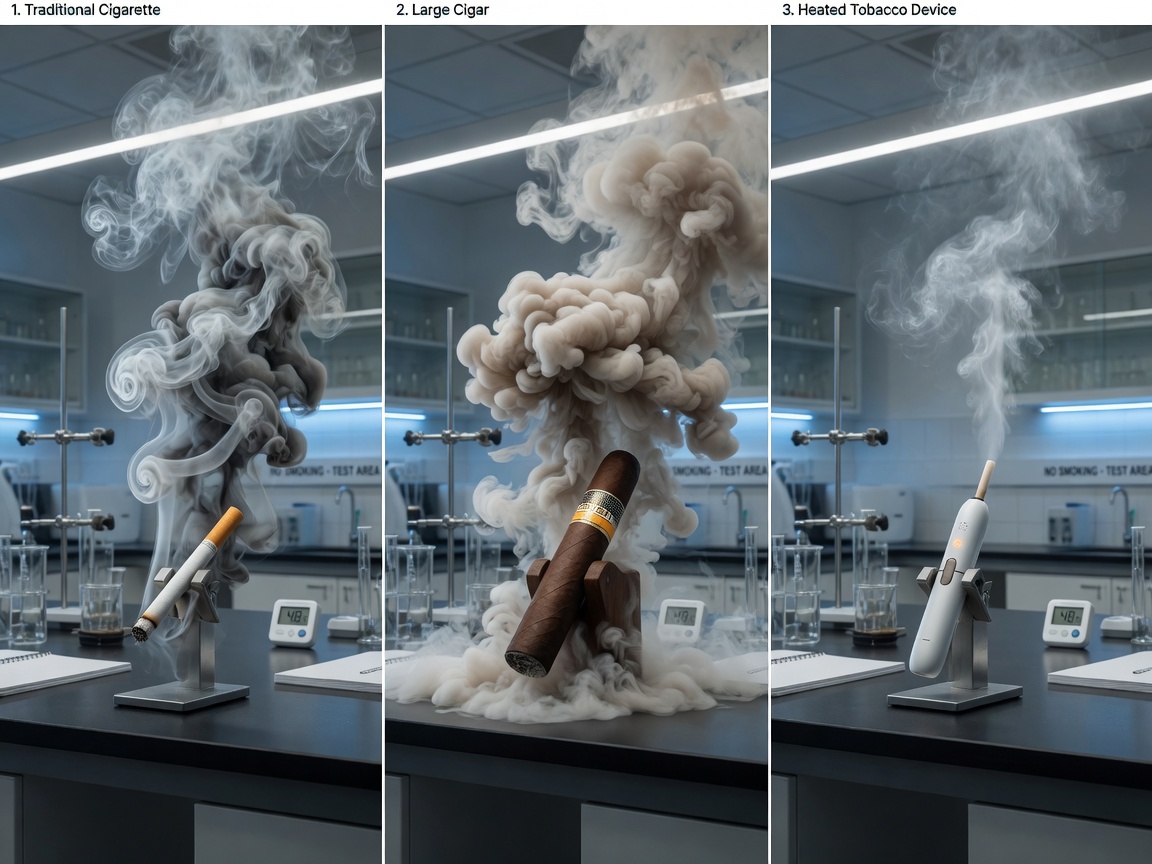
Getting the measurement right: volume, particulate matter, and chemical load are not the same scale
A smoking machine records a set volume. For example, the ISO standard regimen is 35 mL per puff, 2 seconds duration, once every 60 seconds; the Health Canada Intense (HCI) regimen is 55 mL per puff, 2 seconds, once every 30 seconds, with cigarette filter vents blocked. These two regimens can produce very different results for the same cigarette, which means the single "tar" value on packaging is by no means a fixed intake in real human use. ISO 4387:2019 specifies the determination of total particulate matter (TPM) and dry particulate matter after removal of nicotine and water; the Canadian T-115 method clearly lists the HCI parameters of 55 mL, 30 seconds, and the filter weighing procedure.
A common mass indicator in the laboratory is TPM: each puff is drawn through a pre-weighed glass fiber filter pad, which is re-weighed after the session — the mass difference is the captured particulate matter; nicotine can be measured by extracting the filter pad, and water must be deducted separately. Gas-phase components such as carbon monoxide (CO) should not be captured on this filter pad but rather collected in gas bags or analyzed inline. Aldehydes are typically analyzed by DNPH absorption tubes followed by liquid chromatography. In other words, simply saying "smoke volume 10 mg" without specifying whether it refers to TPM, nicotine, CO, or visible concentration makes the information nearly incomparable.
I would require a qualified comparison report to include at least: product batch and conditioning time, number of puffs per stick/per puff, puff volume and interval, whether vents were blocked, TPM collection method, gas sampling location, and whether each indicator is "per stick," "per puff," or "per gram of tobacco." Missing any of these items significantly reduces the comparability of the numbers.
Cigarettes: high-temperature combustion turns tobacco into a continuous smoke source
The burning tip of a lit cigarette is not a constant-temperature furnace: during puffing, the temperature near the combustion cone can locally exceed 800°C; during the inter-puff interval, the temperature drops, while pyrolysis, distillation, and smoldering continue. High temperature and oxygen supply together drive combustion and incomplete combustion, generating mainstream smoke containing solid/liquid particles and gas-phase components. It also continuously releases sidestream smoke, so even when no one is puffing, the burning tip continues to alter indoor air.
The "heaviness" of cigarette smoke is not determined solely by tobacco weight. Cut width, expanded tobacco proportion, paper permeability, and rolling density affect ventilation and burn rate; humectants and formulation affect moisture and volatile substances; the filter and filter ventilation holes alter the mixture ratio reaching the puffing end. Filters can trap some particulate-phase material but do not turn cigarettes into a low-risk product. Especially in real-world smoking, fingers or lips covering the ventilation holes, increasing draw force, and shortening the interval all reduce dilution air, causing the low TPM values measured by the machine under ISO conditions to lose their representativeness.
Cigars: not simply "no filter means more smoke"
Cigars typically contain more tobacco fill, have a larger diameter, take longer to smoke, and mostly lack filters; this means the total amount of tobacco burned and the total emission potential per complete use are high. But cigars are not a uniform category: small cigars, machine-made cigars, and handmade long-filler cigars differ greatly in filler, wrapper, draw resistance, and burn rate. Long-filler cigars commonly use whole leaf filler, resulting in more uneven air channels and combustion zones; some blends use chopped leaf, reconstituted tobacco, or expanded filler, making permeability completely different.
On August 12, 2026, when I compared testing methods, the most easily overlooked issue was not whether the cigar has a filter, but whether the puffing regimen can cover its longer smoking cycle. If a cigar lasting dozens of minutes is forced into a fixed-puff-count program designed for cigarettes, the filter pad may experience breakthrough, and the combustion state may drift. Experimenters should record the mass loss before and after each puff, the burn line, draw resistance, and actual puff count; if a brown penetration mark appears on the back of the filter pad, it should be judged as particulate capture failure or at least requiring retesting. The Canadian method explicitly lists this phenomenon as "breakthrough" when the glass fiber filter capacity is exceeded.
The absence of a filter means one fewer layer of particulate trapping medium, but this alone cannot be used to derive a specific multiplier. What matters more is how much tobacco is burned per use, how large each puff is, whether the smoke is inhaled, and how long the session lasts. Even without deep inhalation, the oral cavity and upper airway still come into contact with harmful substances in tobacco smoke; describing cigars as "only in the mouth, therefore harmless" is incorrect.
Heated tobacco: white mist comes from aerosol formation, not zero emissions
HTP aims to heat tobacco to approximately 250–350°C operating range, rather than maintaining the high-temperature combustion of a cigarette burning tip. Water, glycerin/propylene glycol aerosol formers (depending on product design), nicotine, and volatile tobacco components escape and condense into micro-droplets, forming a visible aerosol. WHO's information page specifically discusses priority chemicals and measurement methods for HTP emissions, indicating that this is not something that can be dismissed with a single phrase like "water vapor." WHO TobLabNet information page.
Lower temperature typically means lower emissions of many toxicants associated with high-temperature combustion, and there is no continuous burning tip generating traditional sidestream smoke; but "lower" does not mean "zero," nor does it imply that all risks or all chemicals decline proportionally. Device temperature, stick insertion depth, cleaning status, and consecutive puffing can alter localized temperature. A non-compliant consecutive puffing test is especially likely to show decreased aerosol output, the appearance of burnt flavor, or an increase in certain thermal decomposition products. Research reviews also indicate that a substantial portion of HTP literature is industry-funded, so priority should be given to comparing independent studies, full methods, and raw data rather than citing a single "percentage reduction." Related review.
How a verifiable comparison should be conducted
| Cigarettes | Cigars | HTP |
|---|---|---|
| Machine-made, with filter | Whole/reconstituted wrapper, no filter | Heated 250-350°C, no combustion |
| Burn tip >800°C, continuous burn | More filler, larger diameter, >10min | Controlled heating, not water vapor |
| ISO: 35mL/2s/60s or HCI: 55mL/2s/30s | Record actual puffs & duration | Per product, watch consecutive puffs |
| Filter traps some particulate | No filter, not simple multiplier | Aerosol formation, visible mist |
| Vents can be blocked, dilution reduced | No ventilation mechanism | Device temp & cleanliness affect emissions |
| Sidestream smoke continuous | Long burn, high total emissions | No continuous sidestream |
If conducting an emission comparison of the three product categories in a laboratory, I would group them in the same location under the same batch conditioning environment, with at least 5 replicates per group, and record the following in the original documentation:
1. Record product model, length, diameter, initial weight, filter ventilation holes, and visible filler characteristics; condition according to applicable standards, number each stick individually.
2. First, use the smoking machine program appropriate for the product: for cigarettes, report both ISO and HCI results; for HTP, set puff count and interval according to product instructions and validated methods; for cigars, report actual burn duration and total puff count, not just "per stick."
3. Mainstream split sampling: glass fiber filter pad for TPM; gas-phase line for CO and volatile carbonyls; additionally use a real-time particle counter for number concentration and decay. For HTP, sampling line temperature and condensation loss must be noted, otherwise low-boiling/semi-volatile components will be underestimated.
4. Check filter breakthrough, air leaks, puff flow calibration, and whether combustion extinguishes in each round; list blanks, replicates, and anomalous samples separately, do not use averages to mask failed operations.
5. Present results on three bases simultaneously: "per puff," "per stick (or per cigarette)," and "per gram of tobacco," with standard deviations. This allows separation of the effects of puffing intensity, product size, and material differences.
My conclusion is straightforward: the core variable for cigarettes and most traditional cigars is combustion; for HTP, the core variable is controlled heating and aerosol generation. Filters, filler, and ventilation can significantly alter measured particulate matter, but they cannot turn any tobacco product into a safe product. If the goal is to reduce health damage, do not use "the smoke looks lighter" as a self-judgment; treat it as a technical observation in the cessation process, and the ultimate goal should be to break free from tobacco and nicotine dependence.
Conclusion: The core variable for cigarettes and traditional cigars is combustion; for HTP it is controlled heating and aerosol generation. Filters, filler and ventilation can alter measured particulates but cannot make any tobacco product safe. If the goal is to reduce health damage, don't use 'the smoke looks lighter' as a judgment; treat it as a technical observation in cessation — the ultimate goal is freedom from tobacco and nicotine dependence.
ISO: International Organization for Standardization; HCI: Health Canada Intense; TPM: Total Particulate Matter; CO: Carbon Monoxide; HTP: Heated Tobacco Product
Note: Data in this article are from published technical literature and standard methods, for technical reference only. Any tobacco use carries health risks.